This weekly money summary reviews what happened from Saturday, October 24, to Friday, October 30, 2026: the dollar rose sharply against the Mexican peso, the Fed left interest rates unchanged, gasoline prices continued to fall, and there were updates on Social Security, SNAP, Obamacare, and tariffs.
Why it matters: almost all of these topics affect your family budget: what a money transfer yields, what a debt costs, what fuel costs, when a deposit arrives, or what aid you might lose. Here's the essential information and upcoming dates.
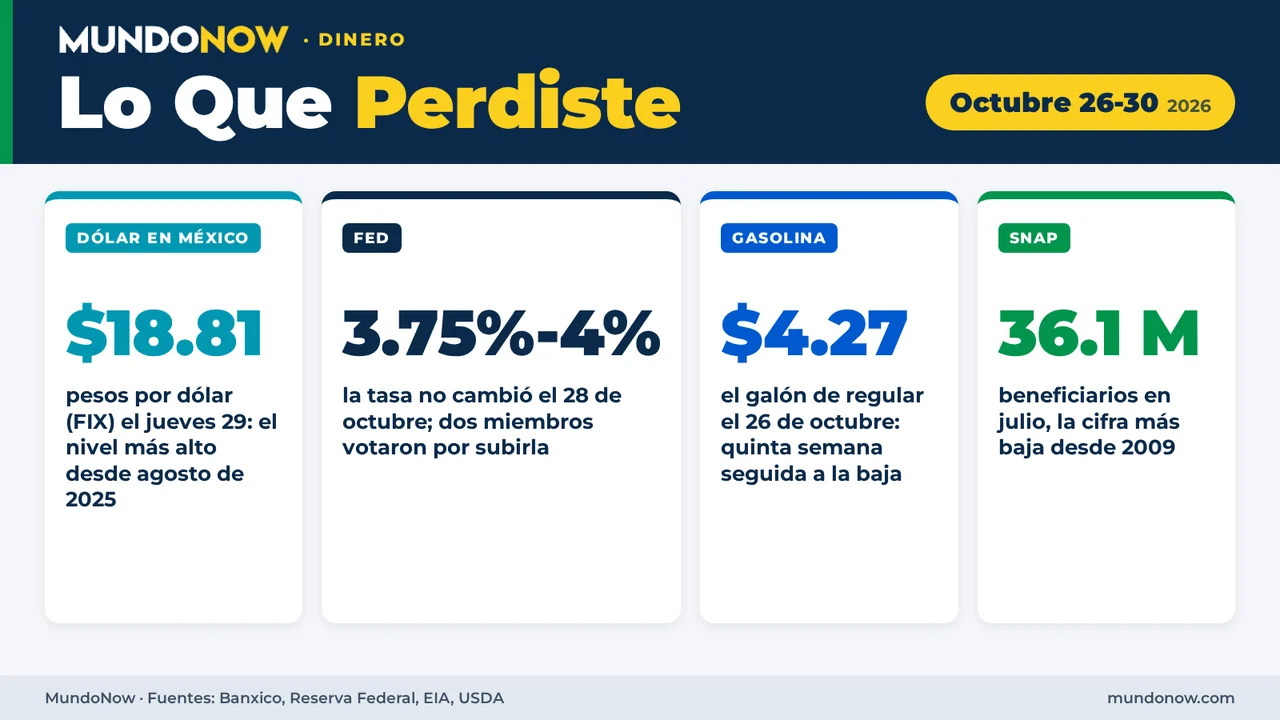
The FIX exchange rate set by the Bank of Mexico (Banxico) on Thursday, October 29, was 18.8148 pesos per dollar. This is the highest level since August 4, 2025 (18.8783) and the highest so far in 2026. In one day, it rose 0.8%, from 18.6673 on Wednesday, October 28. In three business days, from 18.5798 on Monday, October 26, the increase was 1.3%.
With this data, 200 dollars are equivalent to 3,762.96 pesos, and 500 dollars are equivalent to 9,407.40 pesos. This is a reference rate: banks, exchange houses, and money transfer companies apply their own rate and commissions, so it's a good idea to compare the final amount your family will receive. In Colombia, the Representative Market Exchange Rate in effect on Friday, October 30, is 3,166.91 pesos per dollar, practically unchanged from the previous day.
Read more: The dollar rises to 18.81 pesos in Mexico, its highest level since August 2025
Before the meeting, a Reuters survey indicated that the rate would be maintained: 94 out of 100 economists expected it, and all 100 predicted an increase in December. That's what happened. On Wednesday, October 28, the Federal Reserve left the federal funds rate target range at 3.75%-4%, following the 0.25-point increase in September.
The vote was 10 to 2. Lisa D. Cook and Beth M. Hammack voted against raising the rate by a quarter point. The statement describes economic activity as expanding «at a strong pace» and notes that «inflation remains elevated»: the consumer price index rose 3.7% in the 12 months ending in September, and unemployment was 4.2%. For your wallet, this means credit won't get cheaper: check whether your card or loan has a variable rate, pay off the highest-interest debts first, and compare savings accounts and certificates of deposit. The next meeting will be on Tuesday, December 8, and Wednesday, December 9.
Read more: Fed decision on October 28: what to expect and how it may affect your wallet.
Read more: The Fed maintains interest rates, but two members request an increase.
According to the Energy Information Administration (EIA), as of Monday, October 26, regular gasoline averages $4.269 per gallon nationwide. It fell 1.5 cents in the week, its fifth consecutive decline, and is the lowest price since September 7. However, it's still $1.234 more than a year ago.
The national average hides regional differences. In the Midwest, the price rose 12.4 cents, and in Ohio, it reached $4.380 (+33.1 cents). The West Coast is the most expensive region at $5.417, and the Gulf Coast is the cheapest at $3.702. Diesel advanced for the second week in a row to $6.352 per gallon and is $2.634 higher than a year ago. Compare prices near you before filling up and combine errands into a single trip.
Read more: Gasoline prices fall for the fifth week, but rise in the Midwest and diesel increases.
The November payments from the Social Security Administration (SSA) will be distributed on the following dates:
1. Tuesday, November 3: For those who began receiving benefits before May 1997 or who receive both Social Security and SSI.
2. Tuesday, November 10: For individuals born between January 1 and January 10.
3. Wednesday, November 18: For those born between November 11 and November 20.
4. Wednesday, November 25: For individuals born between November 21 and November 30.
Please note that payments for those born January 1-10 will be released early on November 10 due to Veterans Day, a federal holiday.
This November, there is no SSI payment; the payment was made early on October 30 because November 1 is a Sunday. The 3.6% increase will be reflected in January 2027 benefits, with SSI payments starting on December 31.
Read more: Social Security in November: the first payment arrives on Tuesday, November 10, and there will be no SSI deposit.
In addition, the SSA reminded us on Tuesday, October 27, that if you were married for at least 10 years, you may be eligible to receive benefits based on your ex-spouse's work history. You must be 62 or older and not remarried. You can receive up to half of the benefit your ex-spouse would receive at their full retirement age, and receiving it does not affect their benefits or those of their new family. If you are also eligible for a benefit based on your own work history, the higher benefit will be paid, not both. To request an estimate, call 1-800-772-1213; they answer in Spanish from Monday to Friday, from 8 a.m. to 7 p.m.
Read more: Social Security for divorced individuals: how to receive benefits based on your ex-spouse's work history.
The Department of Agriculture (USDA) published a proposed rule on Friday, October 23, to require states to switch to EBT cards with chip and contactless payment capabilities, thereby curbing the theft of SNAP benefits. The proposed deadline is two years after the final rule. States would have to offer options such as blocking purchases outside the state or online, setting a maximum purchase amount, and receiving purchase alerts. The transaction history would go from 2 to 12 months. This is just a proposal, and comments will be accepted until Tuesday, December 22. In the meantime, do not share your PIN and check your purchases frequently.
Read more: SNAP: the USDA proposes EBT cards with chips and alerts to curb benefit theft.
On the other hand, the number of beneficiaries decreased in July 2026 to 36,087,667 people in 19,636,409 households, the lowest monthly figure since July 2009. In July 2025, there were 41,603,048 people, a 13.3% drop. Arizona had the largest decrease (-50.8%), and Alaska was the only state with an increase (+3.5%). The June and July data are preliminary, and the USDA tables do not explain the causes. If you or your family use SNAP, respond promptly to your state's notices and renewals.
Read more: SNAP falls to its lowest level since 2009: 36 million beneficiaries in July.
The federal government proposed on Friday, October 23, that Obamacare markets verify income, citizenship or immigration status, other coverage, and place of residence before providing financial assistance. This would apply starting from the 2028 coverage year, with a verification period beginning on Sunday, August 1, 2027. Automatic re-enrollment with assistance would be possible only if the enrollee confirms their data annually.
The rule itself estimates that about 332,500 fewer people would enroll each year due to administrative barriers. This is a proposal, not a final rule, and it does not change the 2027 coverage. You can enroll or update your application for 2027 starting on November 1 on HealthCare.gov; have your income, residence, and immigration status documents ready.
Read more: Obamacare: proposal to verify income and immigration status before providing subsidies starting in 2028
President Donald Trump signed a proclamation on Friday, October 23, reordering the 50% tariffs on Canadian products. Certain plywood panels, paper products, machinery, refrigeration equipment, and boxes and crates are being removed. Certain valves, carpets, and waste products, as well as categories of canoes and coffins, are being added. The changes took effect at 12:01 a.m. Eastern Time on Friday, October 30. According to a US official, the total impact remains unchanged.
The tariff is charged even if the product complies with the USMCA rules. Republican Senator Susan Collins, who is seeking re-election on Tuesday, November 3, said that the exemptions help Maine's rural and coastal economy; her Democratic rival, Troy Jackson, sees it differently. If you import products from Canada, ask your supplier or customs agent if they appear on either of the two lists.
Read more: Trump changes tariffs on Canada: what's in, what's out, and the effect on Collins.