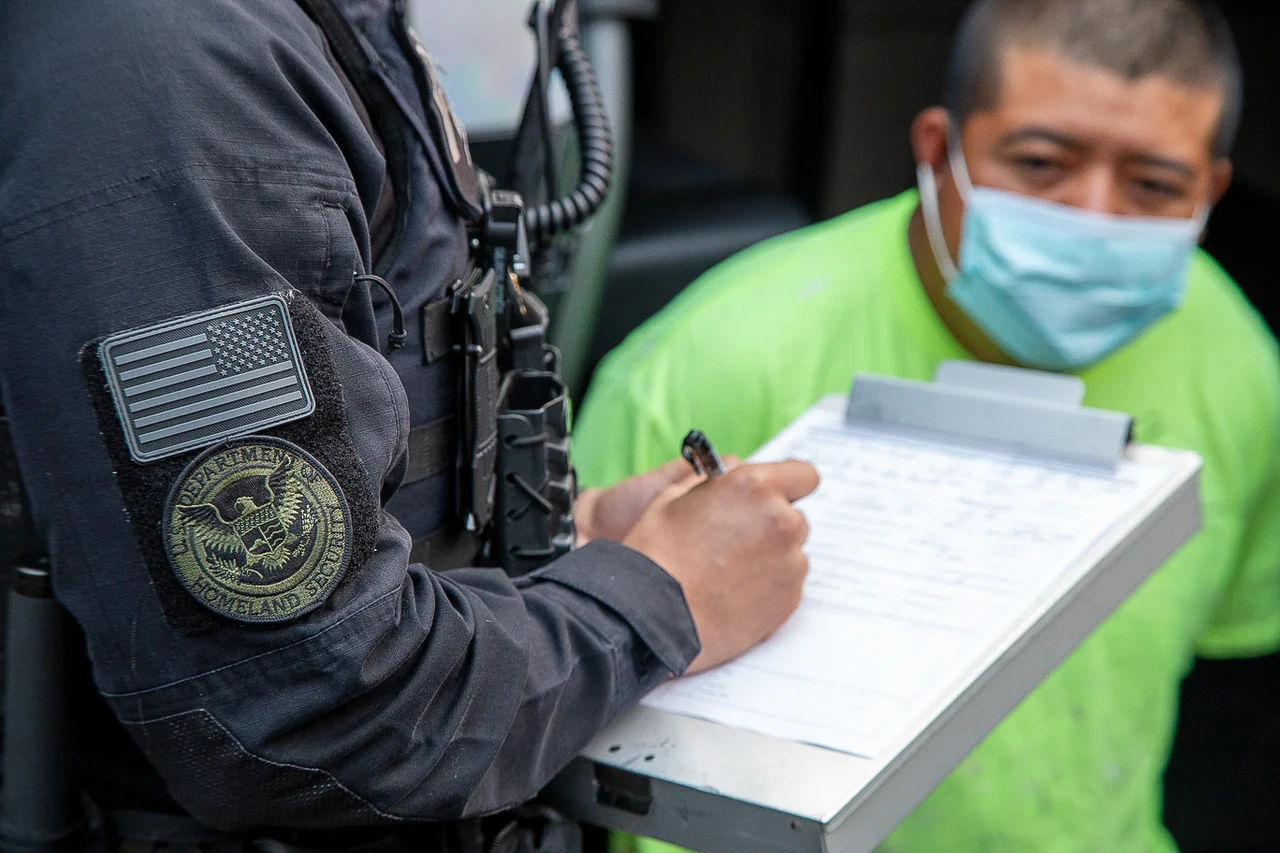
Warrantless immigration arrests face a new legal challenge. A coalition of U.S. state attorneys general filed an amicus brief with the U.S. Court of Appeals for the District of Columbia Circuit in support of a lawsuit challenging the Department of Homeland Security's (DHS) practice of conducting certain civil immigration arrests without warrants.
An amicus curiae brief, meaning «friend of the court,» allows individuals or organizations that are not parties to a lawsuit to present legal arguments or relevant information to help judges consider the case.
In their brief, the attorneys general argue that federal law requires immigration agents making civil arrests without warrants to have probable cause to believe that an individual is unlawfully present in the United States and is likely to flee before a warrant can be obtained.
However, the coalition alleges that federal agents routinely conduct warrantless arrests without determining whether individuals pose a flight risk. The attorneys general argue that these practices have caused «serious harm» to communities nationwide, undermining public health, safety, education, and local economies.
Federal agents' use of face coverings, dark sunglasses, civilian clothing, and unmarked vehicles, along with their alleged refusal to identify themselves during enforcement operations, has contributed to fear and uncertainty in affected communities, the attorneys general said in a joint statement.
The coalition noted that President Donald Trump had promised to deport violent criminals but accused his administration of instead «terrorizing» communities through warrantless arrests that the attorneys general described as error-prone and lacking legal justification. They also alleged that the operations have separated parents from their children and disrupted local businesses.
«His hyper-aggressive, rushed, and chaotic actions have caused unnecessary deaths and injuries. There is a reason why basic due process exists in the United States, and Trump needs to learn to respect the law,» Connecticut Attorney General William Tong said in connection with Escobar-Molina v. DHS, a class-action lawsuit filed in 2025.
The coalition emphasized that the states and territories represented collectively are home to more than 30 million immigrants, who account for approximately 19% of the national workforce and play «crucial» roles in local economies, schools, public services, and civic life.
The attorneys general therefore argue that their states have a «substantial» interest in ensuring that federal immigration enforcement complies with the law, maintains public trust, protects community stability, and respects the limits established by Congress. Those requirements include individualized probable-cause assessments of both a person's immigration status and the likelihood that the individual will flee before a warrant can be obtained.
The coalition includes the attorneys general of Arizona, California, Colorado, Connecticut, Delaware, Hawaii, Illinois, Maine, Maryland, Massachusetts, Michigan, Minnesota, Nevada, New Jersey, New Mexico, New York, Oregon, Rhode Island, Vermont, Virginia, and Washington, as well as the District of Columbia.