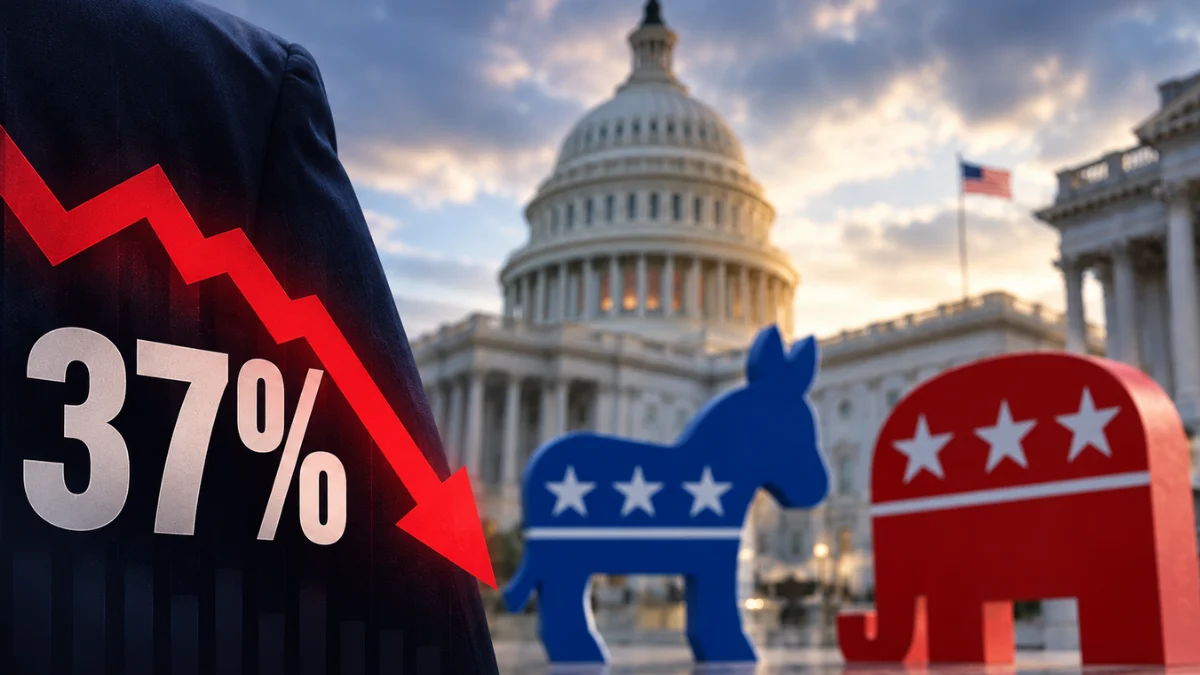
President Trump's approval rating has reached a low in the Wall Street Journal's pre-election polling series, while prediction markets reflect uncertainty over control of Congress.
Trump approval rating fell to 37% ahead of the November 3 midterm elections, according to a Wall Street Journal poll.
Trump has expressed confidence that Republicans will perform well in the November elections, even as the numbers show a more complicated political environment.
The Wall Street Journal reported concern among strategists, lawmakers, and Republican candidates competing in key races just weeks before the election.
Part of that concern also appears in states where Republican candidates face pressure over the cost of living, particularly fuel prices.
Trump himself has tried to mobilize his supporters. On Truth Social, he asked MAGA voters to act as if he were on the ballot and promised to support Republican candidates.
President Trump’s 37% job approval rating is the lowest of any president before a midterm election (note: polling data goes back to 1990). https://t.co/T75ttFS9qH
— Charlie Bilello (@charliebilello) September 28, 2026
Another indicator followed by political observers is sending signals about congressional control, although it measures something completely different from a poll.
Polymarket showed active prediction markets on which party would control the Senate after the midterm elections.
The platform also offered a separate market on control of the House of Representatives.
Therefore, those numbers can change continuously as new polls, news, economic information, or new bets enter the market.
Polymarket: Democrats are now favored to take back the Senate (63% probability) and the House (93% probability) in the midterm elections, the highest odds to date… https://t.co/K4jnXdA5Oh
— Charlie Bilello (@charliebilello) September 28, 2026
The drop in presidential approval and movements in prediction markets are occurring simultaneously, but that does not demonstrate that one indicator is causing the other.
It also does not mean that prediction-market prices determine who will ultimately control either chamber after the election.
Currently, Republicans control the Senate 53-47, while 35 Senate seats will be contested during this election cycle.
For Trump, the outcome will determine which Congress he will have to work with during the final two years of his term.
Current indicators describe a period of political pressure for Republicans, but it will be the votes cast and certified that ultimately determine who controls Congress.
You may be interested in: Trump Amplifies Calls to Replace María Elvira Salazar After Immigration Clash
SOURCE: The Wall Street Journal / Polymarket