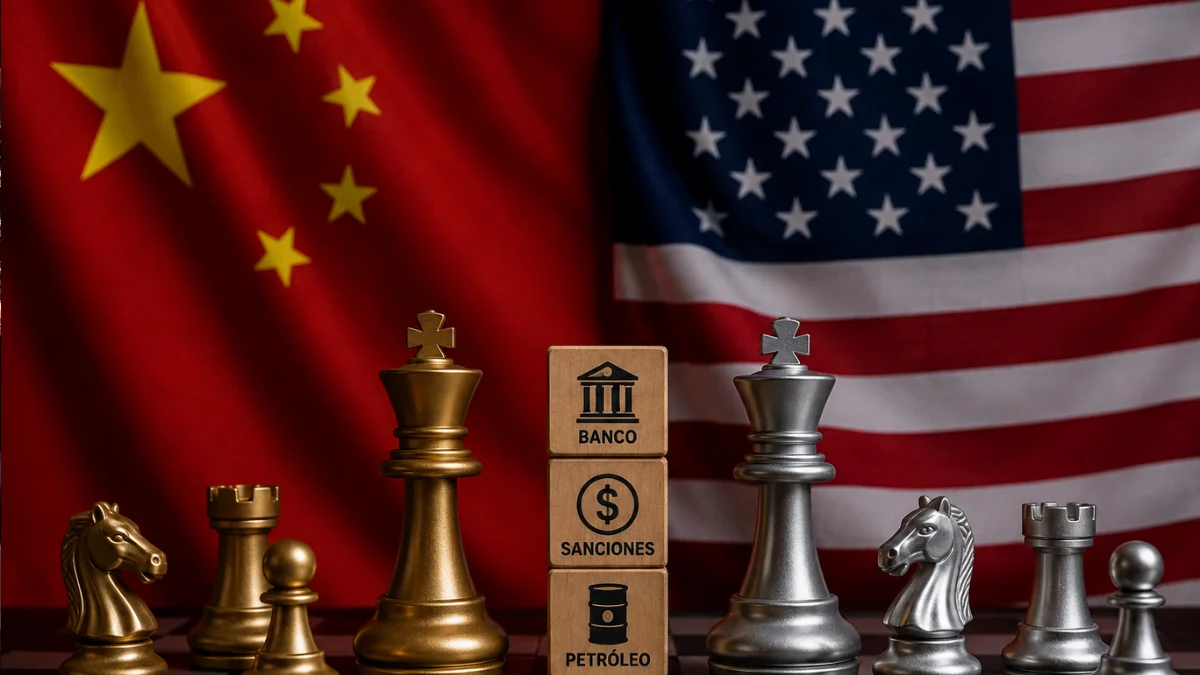
Threats to sanction Chinese banks over ties to Iran raise the cost of the conflict with Tehran: Washington could end up straining its economic relationship with Beijing.
President Donald Trump opened the door to sanctioning Chinese banks as his administration intensifies its campaign to cut off Iran's sources of income, according to CNBC and Politico.
🇺🇸🇮🇷🇨🇳 Journalist: Why not sanction Chinese banks doing business with Iran?
Trump: Who said I'm not doing it? You don't know if I'm doing it. I don't have to announce everything. pic.twitter.com/mfqzEAqBuK
— El Ojo (@ElOjoEn) August 28, 2026
Trump said on Thursday that he could be sanctioning Chinese banks, although he avoided confirming specific measures. «I don't have to announce everything,» he responded to journalists, according to CNBC.
The warning comes after the launch of Operation Economic Outcast, an offensive announced by Treasury Secretary Scott Bessent to shut down Iran's international financial connections.
Bessent warned that Chinese banks that are part of the system used to convert Iranian oil into income could become targets.
#Urgente US dismantles a network of hackers linked to China that infiltrated NASA, the Federal Reserve, and the Senate
CYBER ESPIONAGE ALERT: The Department of Justice and the FBI dismantled QScan and QTRouter, two platforms used by China-sponsored hackers to… pic.twitter.com/vgOyD4uFlw
— Maibort Petit (@maibortpetit) August 26, 2026
The challenge for Washington is that China holds a central position in Iranian oil exports.
Politico notes that independent Chinese refineries buy around 90% of the crude exported by Iran, and provincial banks participate in some of those financial operations.
Sanctioning large Chinese state-owned banks would, however, be a significant leap.
China has rejected the US threats. Its Ministry of Foreign Affairs warned that new sanctions over the Iran conflict could increase tensions and disrupt the international economic and financial order.
The White House faces a delicate decision: intensify the isolation of Iran without provoking a new economic confrontation with China.
The tension coincides with preparations for a visit by Chinese President Xi Jinping to Washington next month.
A campaign against major banks could also provoke Beijing's retaliation on trade, critical minerals, or supply chains, risks raised by lawmakers cited by Politico.
Sanctions such as financial pressure are part of a broader strategy to project dominance over Iran and those who maintain ties with its economy.
Trump's recent statements on Chinese espionage and his message on the Strait of Hormuz increase that image of confrontation, although available information does not demonstrate a relationship between those episodes.
That step would show how far Trump is willing to take the pressure on Beijing to try to close Iran's last economic avenues.
The offensive against Iran thus leaves Trump facing a broader decision: maintain pressure on smaller businesses and entities or risk hitting major Chinese banks.
You May Be Interested In: Socialism Concerns 63% of US Voters: A Problem for Democrats?
SOURCE: The White House / POLITICO / NBC