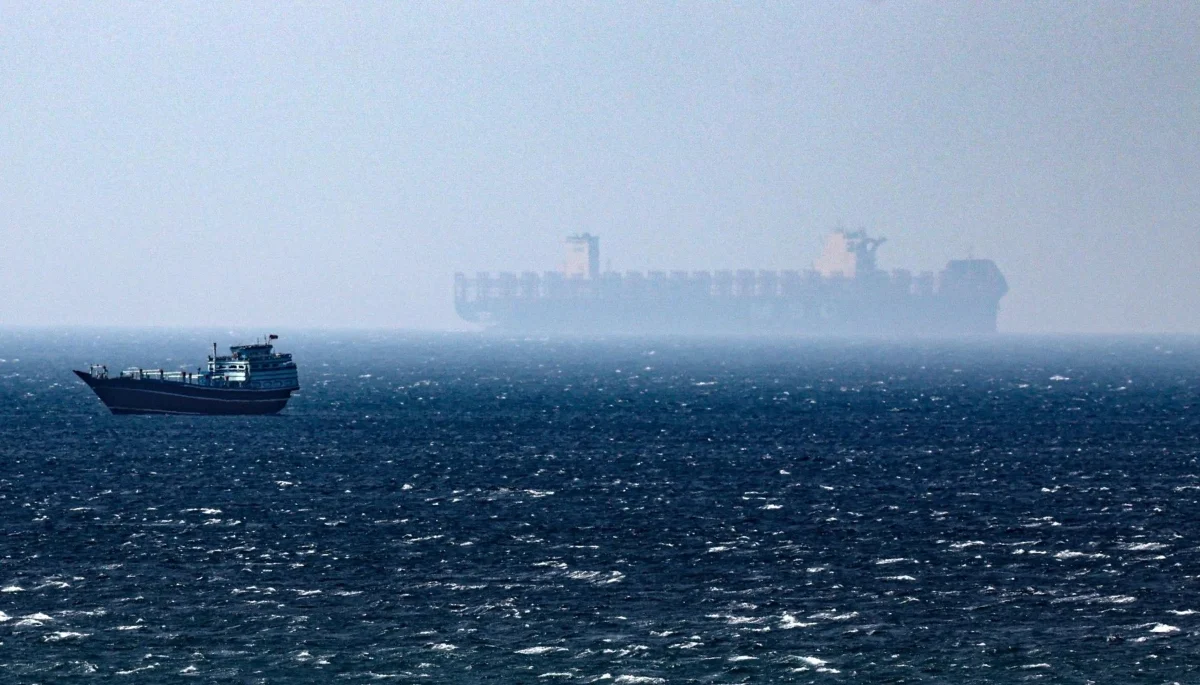
Iran's Revolutionary Guard claims the vessels attempted to cross without authorization. One was carrying over two million barrels of oil.
Iran's Revolutionary Guard reported on Sunday, November 15, the sinking of two oil tankers in the Strait of Hormuz after they hit naval mines.
– Why it matters: The incident increases tension over one of the main routes for global oil trade, amid conflict between Iran, the United States, and Israel.
Two oil tankers suffered strong explosions after colliding with naval mines in the Strait of Hormuz, and one of them sank in the waters of the Persian Gulf, according to Iran's Revolutionary Guard. https://t.co/LKDoVdMrf2
— EFE News (@EFEnoticias) November 15, 2026
According to a statement by Iran's Revolutionary Guard, the two vessels suffered strong explosions while navigating the southern route of the Strait of Hormuz.
Iranian authorities claim that the tankers attempted to cross the area without authorization and with their identification and positioning systems turned off.
They also accused the US Army of supporting the operation, although the statement did not present independent evidence to confirm this involvement.
YOU MAY BE INTERESTED: El Niño could reach historic intensity: what NOAA anticipates for the coming months
– The accusation: Iran claims that the ships attempted to cross clandestinely and used unauthorized routes by its Armed Forces.
The Revolutionary Guard indicated that both tankers began to catch fire after hitting the naval mines.
The statement did not specify the identity of the vessels or provide information about their crews or possible victims.
One of the affected ships was a supertanker that, according to Iranian authorities, was carrying over two million barrels of crude oil.
The Revolutionary Guard assured that the vessel eventually sank in the southern waters of the Persian Gulf after an explosion and fire.
– The fact: Iran had reported on Saturday that three other tankers were affected by explosions attributed to sea mines.
The information released on Sunday does not clarify whether the two new incidents are related to the three previously announced cases.
Additionally, the sinking of the vessels and the extent of the damage have not been independently confirmed.
The incident occurs in an especially sensitive area for international energy transportation, due to the volume of oil that passes through its waters.
Iran declared the Strait of Hormuz closed after the military offensive launched in February by the United States and Israel against Iranian territory.
Tehran claims that vessels can only safely cross the passage through routes authorized by its Armed Forces.
The United States, on the other hand, rejects the existence of an effective blockade of the strait and claims that it maintains military control of the area.
– The difference: Iran conditions navigation to its authorizations, while Washington claims that it escorts vessels to maintain oil exports.
The US presence is concentrated, according to available information, in the outer part of the maritime passage.
Washington claims that its operations aim to guarantee the continuity of oil transportation from the Middle East to international markets.
The Strait of Hormuz connects the Persian Gulf with the maritime routes used to distribute oil to different regions of the world.
The explosions attributed to naval mines increase the risks for vessels attempting to cross this strategic route.
The situation could also generate new difficulties for crude oil transportation if restrictions and maritime incidents continue.
For now, Iranian authorities have not announced new measures or specified what will happen to the affected vessels.
The main uncertainty remains whether military operations will allow oil traffic to continue without new confrontations.
Sources: Efe, El Economista