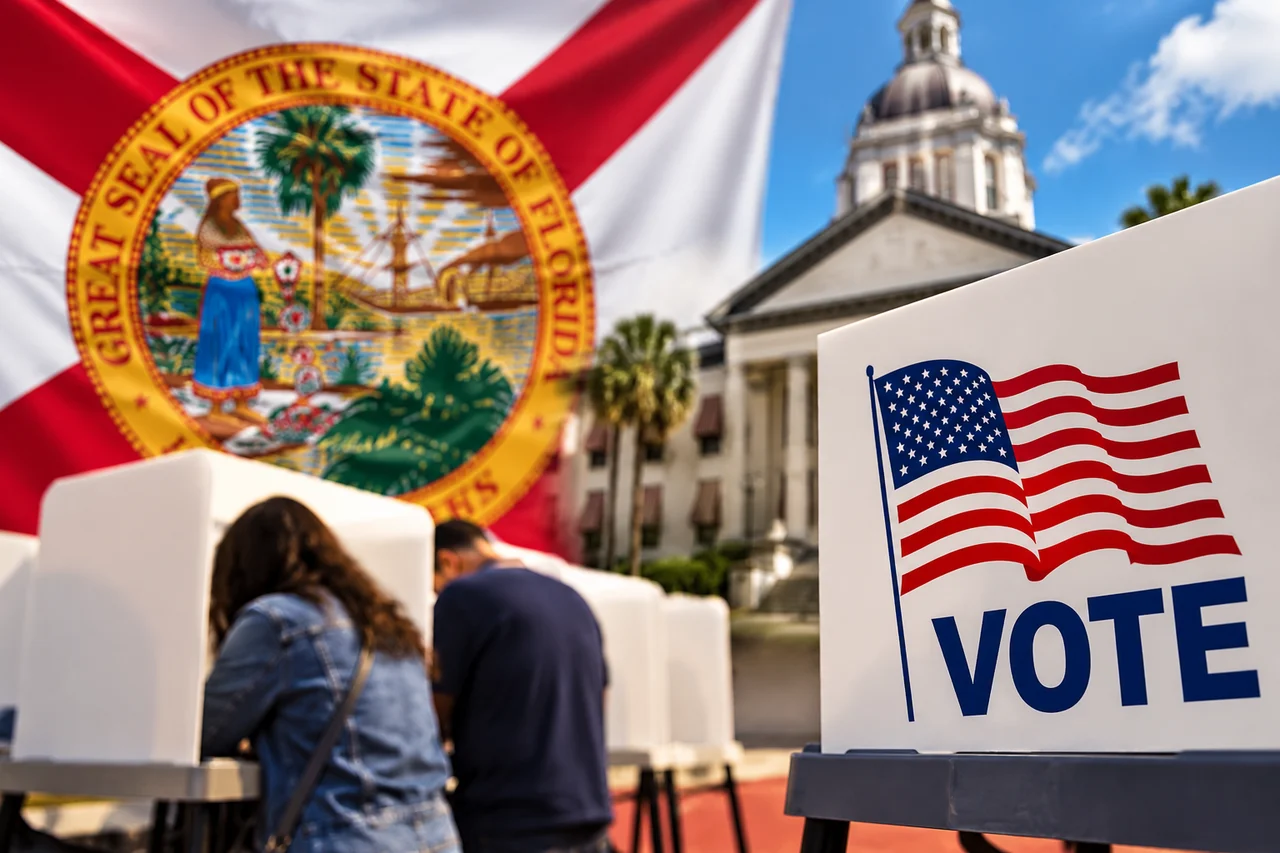
The Florida governor race in 2026 is tightening. With less than two weeks remaining before the midterm elections, Republican Byron Donalds holds a narrow lead over Democrat David Jolly. However, the candidates are statistically tied within the margin of error of a new University of North Florida (UNF) poll.
The survey, released Wednesday, October 21, and cited by the EFE news agency, shows Donalds with 49% support among likely voters, compared with 47% for Jolly. Another 4% remain undecided.
The two-percentage-point gap falls within the survey's overall margin of error of ±2.81 percentage points, meaning the results do not establish a statistically clear lead for either candidate.
The latest results represent a shift from July, when a previous UNF poll showed Donalds leading his Democratic opponent by five percentage points.
Donalds, who has received President Donald Trump's endorsement, is seeking to succeed Florida Gov. Ron DeSantis.
If elected, Donalds would become the first Black governor in Florida's history.
Sean Freeder, director of UNF's Public Opinion Research Lab, attributed the narrowing gap between the candidates partly to broader national political trends associated with midterm elections.
Freeder explained that the party holding the White House often faces electoral challenges during midterm elections. He also pointed to Trump's approval ratings, which have fallen to near-historic lows.
Among Hispanic voters, the Florida gubernatorial race is also extremely close, according to the UNF survey.
Donalds receives 48% support among Hispanic respondents, compared with 47% for Jolly, a difference of just one percentage point.
However, the margin of error is higher for the Hispanic subgroup because of its smaller sample size, meaning those figures should be interpreted cautiously.
The survey also indicates that Donalds faces challenges among Black voters, with only 10% of respondents in that group expressing support for him.
According to Freeder, the figure suggests that Donalds' efforts to broaden his support among Black voters have not produced the results his campaign may have hoped for.
The UNF poll also examined the race for the U.S. Senate seat previously held by Marco Rubio, who left the position to become secretary of state.
Republican Sen. Ashley Moody, who was appointed to fill the vacancy, receives 49% support, compared with 45% for Democratic challenger Angie Nixon.
Although Moody holds a four-percentage-point lead in the survey, the gap has narrowed since July, when she led Nixon by eight points.
Republicans maintain a substantial voter registration advantage in Florida, with more than 1.5 million additional registered voters compared with Democrats, according to official figures as of September 30.
Nationally, Republicans currently hold 53 seats in the U.S. Senate, compared with 47 held by Democrats and independents who caucus with them.
The UNF poll surveyed 1,471 likely voters through telephone interviews conducted in English and Spanish between October 12 and 19.
The findings show that Florida's gubernatorial race has become more competitive since July, although a single poll cannot reliably determine the outcome of the November 3 election.