The federal operation will mobilize ICE agents ahead of the November midterm elections, while questions remain about the difference between suspicious voter registrations and confirmed fraud.
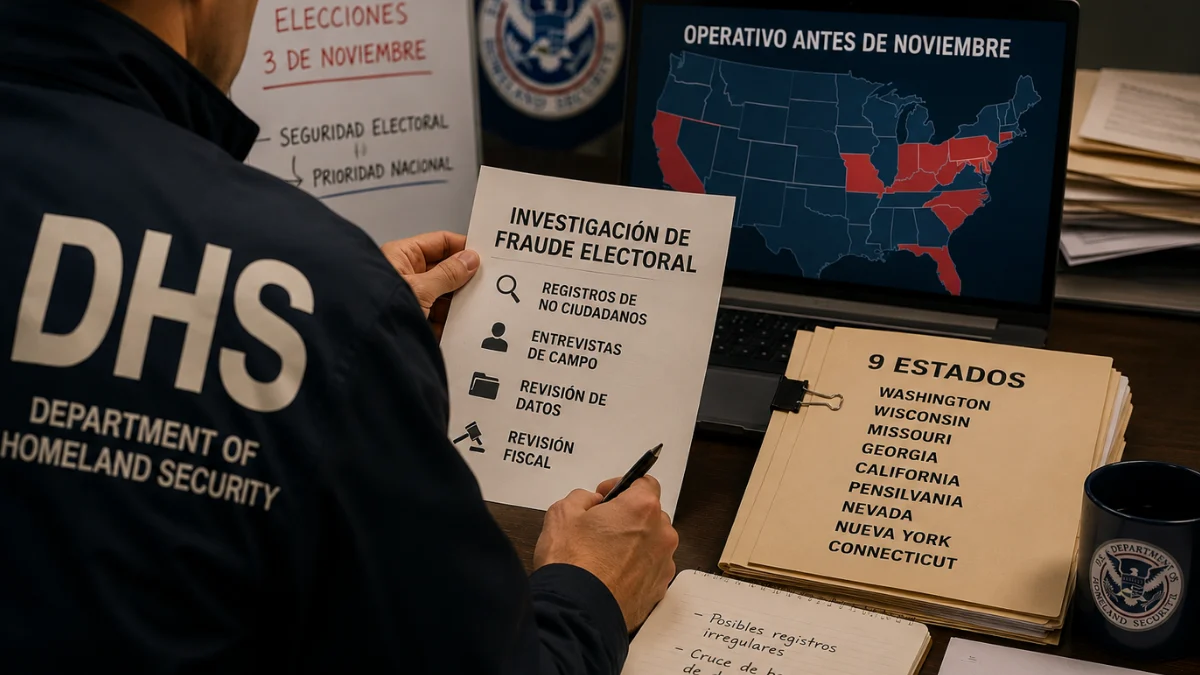
The Department of Homeland Security (DHS) will intensify investigations into possible voter fraud in nine states beginning Tuesday, according to an internal guide obtained by CNN.
DHS Voter Fraud Investigation in 9 States Before November Elections – PHOTO: AI-generated reference image Homeland Security Investigations (HSI), the ICE division specializing in crimes such as drug trafficking and human trafficking, will lead the initiative.
According to CNN, agents will conduct interviews, investigate leads, and gather information for possible review by prosecutors between September and mid-October.
DHS says it wants to ensure that only U.S. citizens participate in the elections.
Experts cited by CNN note that there is no evidence of widespread voter fraud in recent elections.
The actual scale of the problem is one of the central questions surrounding the DHS voter fraud investigation.
DHS previously announced that a review had identified more than 250,000 possible noncitizen registrations in California, Pennsylvania, New Jersey, and Nevada.
However, finding a match between voter rolls and immigration databases does not automatically prove that someone is a noncitizen registered illegally, nor does it mean that person voted.
Nevada provides a specific example.
DHS initially identified as many as 15,903 possible noncitizen registrations.
There are also individual cases.
The Department of Justice recently announced charges against a Honduran permanent resident accused of fraudulently registering to vote in California and falsely claiming U.S. citizenship. Authorities said he did not cast a ballot.
The operation is also notable because of its timing.
Historically, Department of Justice policies have recommended limiting public investigative actions close to elections when they could influence campaigns or discourage legitimate voting activity.
DHS is a separate department, and the guide obtained by CNN does not mention those restrictions.
The distinction will be crucial: Investigating thousands of potentially irregular registrations is not the same as proving that thousands of illegal votes were cast.
You May Be Interested: Trump Mail-In Voting Rules Remain Blocked by Federal Judge
SOURCE: DHS / The Guardian / CNN